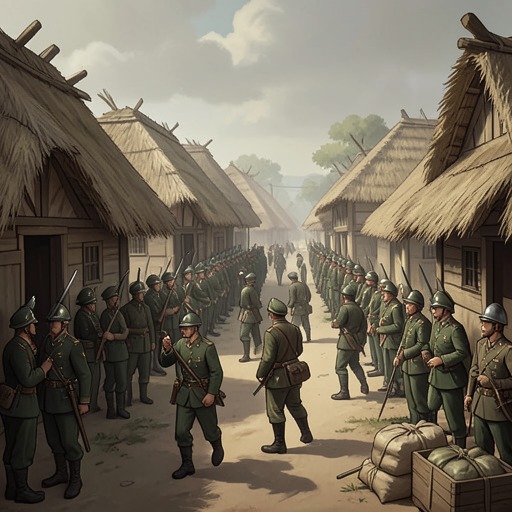
The burning of Veretenniki
Doctor ZhivagoThe burning of Veretenniki is the destruction of Vasia Brykin’s native village, a catastrophe whose causes are recounted as a sequence of events that seemed to happen on their own, while leaving unmistakable human consequences. When Yurii Andreievich comes upon the burned-out settlement, the silence of its deserted houses gives way to Vasia’s account: the young man had hidden in a quarry cave, his mother had died believing him lost, and the surviving villagers had scattered amid fear and rumor.
The Village in Ruins
The destruction is first encountered through its aftermath. On one side of the road, the houses had stood in a row between the road and the riverbank; now only a few blackened buildings remained standing, empty, while the rest had become heaps of charred rubble marked by the chimneys left upright. The village’s absence is made concrete by what remains of its former livelihood: the river cliffs were pitted with quarries where villagers cut millstones, and three unfinished stones still lay outside one of the surviving houses.
Yurii Andreievich enters that house on a still afternoon, but it is no refuge. Straw and hay move across the floor, scraps of paper flutter on the walls, and mice scatter through the abandoned rooms. The ordinary signs of habitation have become signs of vacancy and exposure. The sequence delays any explanation of the fire: the reader sees the ruined place before hearing how the village came to be empty.
Flight, Accusation, and Fire
Vasia explains that, after he evaded labor service and escaped custody, he hid in a cave in the old quarry. Local political tensions had already made the villagers vulnerable to competing accusations. According to his account, a man named Kharlam used an earlier murder to encourage hostility between the village and the town, then carried his report to the authorities and proposed forming a Poor Peasants’ Committee. Vasia says that officials accused him of evading service, fleeing, killing the old woman, and stirring up the village, on the basis of Kharlam’s story.
The account of the fire is notably indirect. Vasia says the Red Army men sent from town were lodged in a house and given liquor; they became drunk, and during the night that house caught fire. The flames spread from house to house. The villagers ran from their homes, while the men from town, Vasia says, were not ordered to flee and died in the fire. His repeated insistence that nobody had informed, ordered, or deliberately set events in motion presents the burning as a chain of actions and failures whose consequences were devastating even as responsibility was obscured.
Fear prolonged the destruction beyond the flames. Vasia says the villagers did not return because they feared something else might happen, and that a rumor spread that every tenth man would be shot. When he eventually emerged from the cave, no one was there; the people had dispersed, and he did not know where they had gone. The village was thus destroyed not only as a settlement but as a place of shared life: flight and suspicion prevented its former inhabitants from gathering again.
Vasia’s Loss and Return
The ruin is inseparable from Vasia’s loss. His mother had thought he had been taken away to town. Not knowing that he was alive in the quarry cave, she drowned herself in the river that ran beneath the cliff. Vasia had survived the fire by hiding nearby, but that survival did not bring him news of his family: he learned of his mother’s death only after the village had been destroyed. His sisters, Alia and Aria, were said to be in an orphanage in another district, but he had no certain knowledge of their whereabouts.
When Vasia meets Yurii Andreievich among the ruins, he throws himself down before the doctor, kisses his hands, and weeps. He tells the doctor that they had traveled in the same train from Moscow and that he had been conscripted for labor and placed in the convoy. Now he goes on to Moscow with the doctor, recounting other terrible events along the way. His departure turns the burned village into part of a wider story of forced movement and family separation, while the uncertainty about his sisters leaves his return without a family reunion or a settled resolution.
Narrative Significance
The episode sets a physical landscape of destruction beside Vasia’s effort to explain how it happened. The village is presented first through tangible remnants—the blackened houses, quarry pits, unfinished millstones, and an abandoned interior—before Vasia supplies a history in which rumor, accusation, flight, and fire overlap. This order makes the burned settlement more than a backdrop: its material emptiness is the result against which the uncertain chain of causes is measured.
Vasia’s account also stresses the gap between responsibility and consequence. He denies that anyone formally ordered the villagers to flee or deliberately set the houses alight, yet people died, the inhabitants dispersed, and his mother’s mistaken belief that he was gone led to her death. The repeated claim that events happened by themselves does not undo those outcomes; it gives the catastrophe its particular shape, in which violence and loss accumulate without a single, fully commanding explanation.